

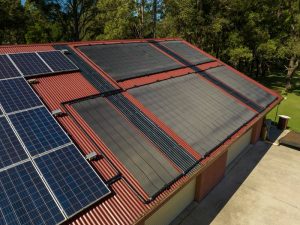
Solar heating extends the swimming season in a way that’s eco-friendly and free of electricity costs. It’s no surprise this solution has built a strong reputation in recent years, and solar collectors mounted on rooftops have become a familiar sight around us. When we talk about solar heating for pool water, it’s important to note that we mean collectors that heat the pool using solar energy, not PV panels that generate electricity from solar energy. In this article, we’ll look at the key differences between the two types of collectors.
How Does a Solar Heating System Work?
A solar pool heating system consists of four main components: a solar collector, a circulation pump, piping, and a control system. The process is fully automatic and works as follows: the circulation pump draws water through the filter to the solar collector. Pool water enters the collector at its lower end and flows upward through the individual tubes of the absorber surface. Solar radiation heats the water in the tubes, and the heated water is returned to the pool. This cycle repeats continuously as long as the circulation pump is running, or until the water reaches the desired temperature.
What Is a PV Panel and How Is It Different?
Generating electricity from solar energy is done using a photovoltaic (PV) cell made of silicon, based on semiconductors that create an electrical field. Sunlight strikes the cell and causes it to release electrical energy. What was once considered a niche interest reserved for environmentalists has today become a mainstream solution: alongside the green agenda, it also offers substantial financial savings, whether for full or partial home electricity needs. For our purposes here, however, heating pool water, this process is less relevant. Why? A PV cell for electricity generation converts only about 15% to 20% of solar radiation into electricity. In other words, its energy efficiency is very low, with 85% of the radiation lost, compared to a solar water heating collector, which converts 70% to 80% of the radiation’s energy. This means the energy efficiency of a solar collector for producing heat is enormous.
Another downside of heating water with a solar electric system lies in the high production costs. The cost per square meter of PV panels is far higher: a PV panel is made of aluminum, while a solar heating collector is made of plastic, at roughly a tenth of the production cost, and it produces four times as much heat as the electricity-generating panel. In short, both economically and technologically, heating a pool with PV panels is not effective: it means high costs and low energy efficiency.
What should a family with a solar electric system do if they want to install solar collectors on their roof to heat their pool? In many cases, the installed PV panels don’t cover the entire roof, leaving room for heating collectors as well. Another option is to install the heating collectors beside the pool, or on a pergola, saving space while also providing shade over the pool.
Questions and Answers
What is the difference between a solar water heating collector and a PV panel?
A solar collector heats the pool water directly, while a PV panel generates electricity. For heating a pool, the solar collector is far more efficient.
Why is a PV panel less efficient for heating a pool?
A PV panel converts only about 15% to 20% of solar radiation into electricity, while a solar water heating collector converts 70% to 80% of the radiation into heat.
Can both systems be combined on the same roof?
Yes. PV panels usually don’t cover the entire roof, so solar collectors can be installed alongside them, or on a pergola near the pool.