

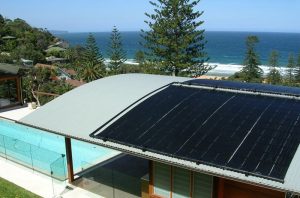
Pool owners everywhere know this scenario: winter has passed, spring is in full swing, and summer is waiting just around the corner, that perfect moment to open the warm season with a refreshing dip in the pool. But in reality, the water isn’t warm enough, and we end up waiting for the truly hot days, a very short window on the calendar, before we can get in. What are the ways to heat a pool so it’s usable as early as spring and all the way through the fall holidays? In the following sections, we’ll look at the advantages and disadvantages of the different pool heating solutions used around the world.
Heating Pools with Gas
The oldest heating method on the market uses a central heating system powered by gas. This traditional method started in public pools (at sports centers where people swim year round) and later moved into home pools, and not without reason: this method gets the job done, with the water heating up quickly and the temperature rising significantly within just a day.
For colder countries like Canada or the Scandinavian nations, this is an effective solution, though not a cheap one. The initial investment is relatively low, which is why this method is still very common worldwide, but in most cases the ongoing running costs are especially high, reaching the equivalent of hundreds of dollars a month. Other drawbacks: this method requires gas piping infrastructure, which many pools don’t have; gas is flammable, so periodic safety inspections are required; pools that have switched to salt-water chlorination can’t use gas heaters because the salt corrodes the heating unit; and on top of all that, this system has a limited lifespan of five to seven years.
Heating Pools with an Electric Heating Element
A less common method today, but still used mainly in South America and South Africa. This involves a large heating element that supplies heat (think of a kettle or water heater, but scaled up to supply an entire pool, a serious volume of water). The clear drawbacks of this method are high electricity consumption and the fact that the heating element can be damaged by scale buildup in a short time.
Heating Pools with a Heat Pump
Heating a home pool this way involves a heat pump that makes smart use of ambient energy. It’s a compressor-based system that works similarly to an air conditioner: some of the heat energy that goes into the water comes from the machine itself, and some comes from converting the ambient temperature into heat. It’s a simple system to operate and easy to install. Compared to heating with an electric element, this method is 25-30% more energy efficient.
That said, this system has quite a few drawbacks. Many people assume heat pumps provide a complete, round-the-clock solution, but in practice their heating capacity is limited at low ambient temperatures. Other drawbacks of this method: the unit can’t be placed in the pool’s equipment room, since it needs to sit outdoors to exchange heat, which can make placement a bit tricky in regions like Israel and Europe; it also contains many mechanical parts, so its lifespan is limited to about seven years on average.
Heating a Pool with a Solar System
This system suits countries with good sun exposure, such as Israel, South American countries, the southern United States, southern Europe, and Australia, where solar heating is the default choice, with 60% of pools in the country using this method. Among its standout advantages: there’s no ongoing cost beyond the initial installation. With proper operation and suitable climate conditions, the investment can pay for itself in under two years, after which owners enjoy the system for many years at no additional cost, powered by the sun. It also has an especially long lifespan, 25 years on average, and is very easy to operate.
A system like this will provide a longer-than-usual swimming season and save pool owners significant money. It also works well in pools sanitized with salt-water chlorinators (the most common method today).
That said, the system requires a longer installation process than a heat pump: piping needs to be run, the roof needs to be accessed, and other steps are involved that take time and, of course, professional skill. Another drawback is its dependence on weather: on rainy, overcast days the system doesn’t work, though in most cases those aren’t swimming days anyway.
Questions and Answers
What are the methods for heating a pool?
Four main methods: gas, electric heating element, heat pump, and solar system.
Which heating method is the most cost-effective?
A solar system. It has no ongoing cost beyond installation, pays for itself in under two years, and lasts around 25 years.
Does solar heating work with a salt system?
Yes. The solar system works well in pools sanitized with a salt-water chlorinator as well.